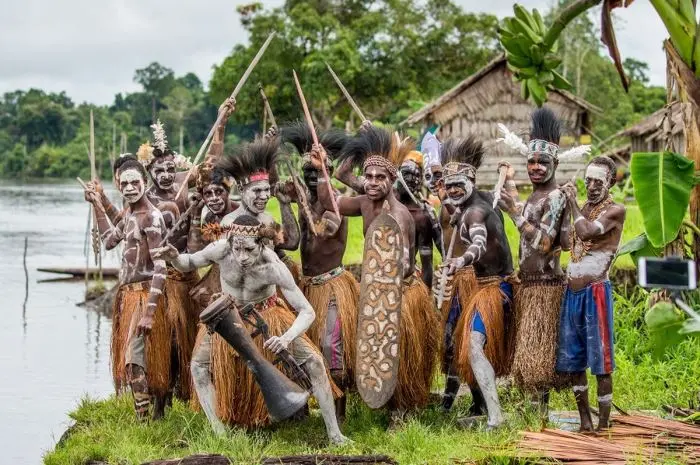
The Asmat tribe in Papua offers a life that is closely connected to nature, from unique traditions, wood carving art, to their way of surviving through hunting, gardening, and gathering sago.
The Asmat tribe is one of the tribes that inhabit the Papua region, precisely in Asmat Regency, which is famous for its culture, traditions, and way of life that is very close to the surrounding nature.
The life of the Asmat tribe is influenced by the harsh natural environment, as well as mythological stories that are passed down from generation to generation.
This community has long been known for their ability to survive in the midst of challenging wilderness. In addition, they are also known for their expertise in the art of carving, which reflects their cultural values and respect for their ancestors.
Physical Characteristics and Daily Life of the Asmat Tribe
The Asmat people have very distinctive physical characteristics. In general, they have tall, large, and sturdy body postures. Their skin tends to be dark, while their hair is generally curly.
Their noses are sharp and their eyes look sharp, giving a strong impression to their appearance. In their daily lives, the Asmat people rely on agriculture and hunting to meet their living needs.
They farm by growing crops such as carrots, sweet potatoes, and corn. However, they also rely on sago as their staple food, as well as raising chickens and pigs. To obtain additional protein, they often hunt wild boar, fish, and catch shrimp.
Apart from farming and hunting activities, the Asmat Tribe has a habit of decorating their bodies with distinctive colors. They used red, white, and black colors that came from natural materials around them.
The red color is obtained from red soil, while the black color is obtained from charcoal, and the white color is produced from crushed seashells. This process is part of their cultural identity, showing their relationship with the surrounding nature.
Female Symbolism and Asmat Carvings
In Asmat culture, women play an important role, even though in reality they often bear a heavy burden. Women in the Asmat Tribe have a highly respected position, which is reflected in their carving and sculpture art.
Flora and fauna forms, such as trees, parrots, and cockatoos, often serve as symbols of women in their art. This shows that women in their culture are associated with life and birth.
However, behind the appreciation of women in art and symbolism, there is a much heavier reality of life. In daily life, women in the Asmat tribe tend to do most of the household chores, such as cutting wood, processing food, and rowing boats.
Meanwhile, men often enjoy life in a more hedonistic way, such as eating food prepared by their wives, smoking, gambling, and getting drunk.
Although they sometimes help in building houses or boats, they often only accompany their wives without playing an active role in the work.
In many ways, life for women in the Asmat Tribe is very demanding, and they must continue to work hard to ensure the survival of their families.
In addition, wood carving is an art form that is highly valued in Asmat culture. Their wood carvings usually focus on ancestral themes, or what are called “mbis”. This shows how much respect they have for their ancestors and traditions.
These carvings are often found on the boats they make, which are believed to be a symbol of the journey of the ancestors’ spirits to the afterlife. Through this carving art, the Asmat Tribe preserves memories and honors their deceased ancestors.
Distribution of the Asmat Tribe in Papua
The Asmat tribe is spread throughout the Papua region, both on the coast and in the interior. They are one of the largest tribes in Papua, with a fairly significant population.
The Asmat people who live in coastal areas, especially around the coast of the Arafura Sea, tend to have an easier life because they are close to natural resources, such as fish and game.
Their lives are more helped by nature, with easier access to clean water and food. On the other hand, the Asmat Tribe who live inland, especially in the Jayawijaya mountains, live in more difficult conditions.
This area is a wilderness with more limited natural resources. The people in the interior of the Asmat Tribe rely on the habit of hunting and gathering sago as their main food source.
In addition, they also have the skills to make tools from stone, which is very valuable in areas where stone is difficult to find.
For them, stone is not just an ordinary object, but also has symbolic meaning, and can even be used as a dowry in wedding traditions.
Natural Conditions in the Asmat Tribal Region
The area where the Asmat Tribe lives, now known as Asmat Regency, has unique natural conditions. This area is known for its high rainfall, between 3,000 to 4,000 millimeters per year.
This creates a very wet and muddy environment, with soft soil covered by small streams and river spider webs. In addition, this coastal area is also affected by the ebb and flow of sea water which continuously enters their residential area.
To overcome these difficult natural conditions, the Asmat tribe has built simple roads by laying wooden planks on the muddy ground. However, access to this area remains difficult, especially when it rains.
Even when walking, visitors must be careful not to slip. Despite the difficulty of access, the Asmat tribe has managed to survive in a way that is very dependent on the surrounding nature.
Livelihood and Way of Life of the Asmat Tribe
The livelihoods of the Asmat people are very dependent on their natural environment. They rely on marine and forest products to meet their living needs.
The Asmat tribe who live on the coast usually hunt fish, shrimp and various other types of animals in the forest. They also mix sago as their staple food, which is a substitute for rice for most Indonesians.
In the interior, the Asmat tribe hunts various types of animals such as wild boar, cassowaries, snakes, and so on, using traditional and simple methods.
In addition, the Asmat tribe also has a gardening tradition. They grow various types of crops such as sweet potatoes, corn, and carrots to meet their food needs.
Their lives are very connected to nature, and they greatly respect the preservation of nature as part of the sustainability of their lives.
The Asmat people are a society rich in culture and tradition, with a life that is very connected to the natural world around them.
Despite the challenges of living in a harsh area, they persist and live their lives in a way that is full of respect for their ancestors and nature.
The uniqueness of their culture, wood carving art, and the tradition of hunting and gathering sago, make the Asmat people one of the most interesting tribes to study.
With a simple yet meaningful life, the Sakti Tribe teaches us about the importance of preserving nature and respecting the traditional values that have been passed down by their ancestors.